Climat & Hydrogène Intégrés Research Simulator V3.2
Un environnement de recherche unifié reliant seawater chemistry, desalination, steam preparation, H₂O–Ar plasma modelling, hydrogen production, thermal recovery, optimization and climate intelligence.
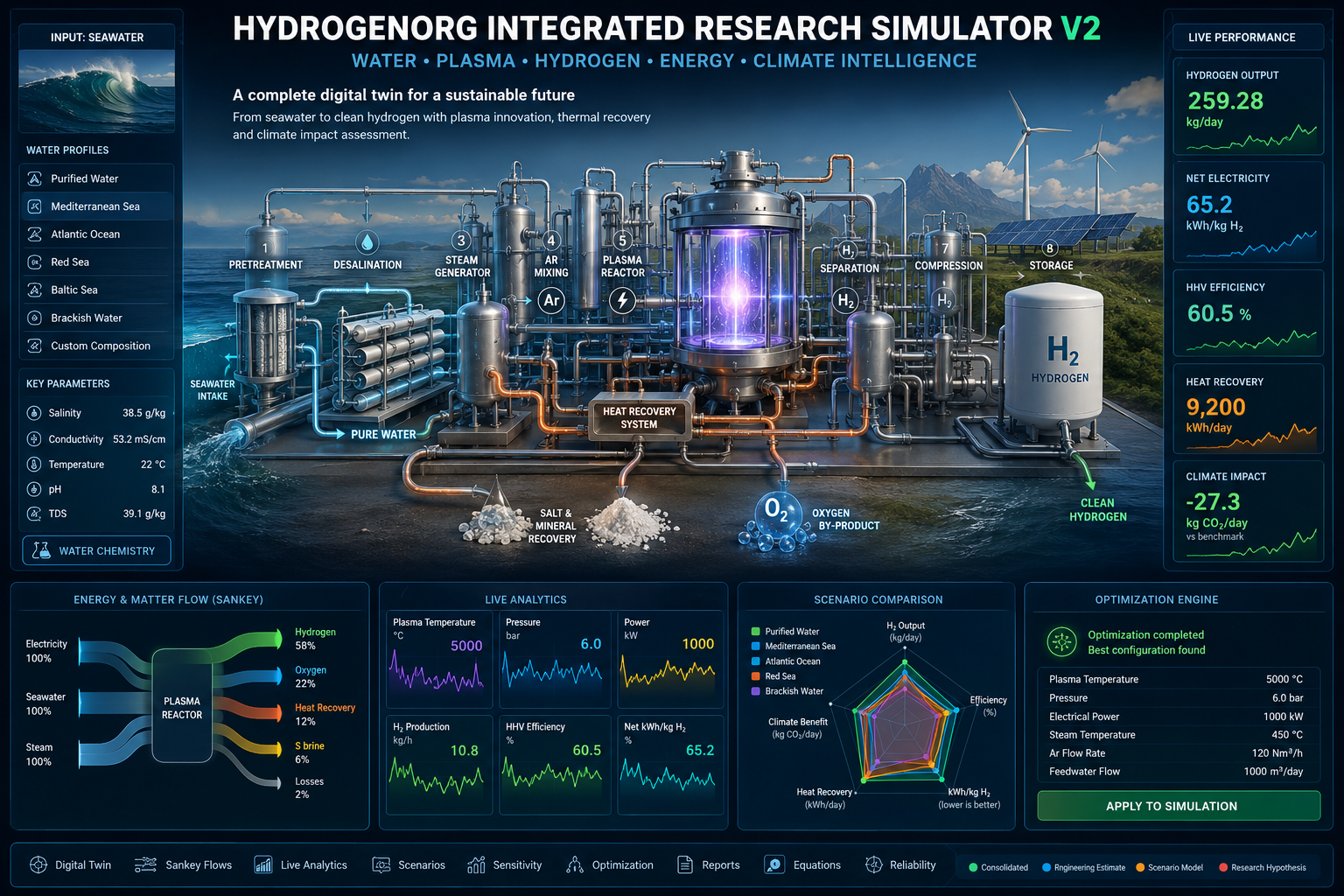
Modélisation transparente pour l'hydrogène propre et l'infrastructure régénérative
HydrogenOrg is developing an open modelling environment to investigate how water chemistry, renewable electricity, plasma-assisted hydrogen, thermal recovery and resource recovery could interact inside future regenerative infrastructure.
One platform for research, engineering and decision support
The interface can be viewed from different perspectives without changing the scientific model underneath.
Scientific exploration
Examine equations, assumptions, water chemistry, sensitivity, scenario comparisons and research limitations.
Process configuration
Review reactor temperature, pressure, power, operating hours, desalination demand, heat recovery and gas-loop assumptions.
Decision-oriented view
Focus on hydrogen output, specific electricity, efficiency, climate delta, validation stage and strategic implications.
A complete integrated research workspace
The simulator combines visual process modelling, scientific transparency, comparative analysis and technical reporting in one environment.
Mission Control
Central overview of hydrogen production, electricity demand, HHV efficiency, climate delta and system state.
Interactive 3D Digital Twin
A rotatable and zoomable conceptual reactor twin showing Steam + Ar entry, plasma reactor, hydrogen separation and heat recovery.
Sankey de l'énergie et de la matière
Visual representation of electricity, water, steam, hydrogen, oxygen, recovered heat, brine and process losses.
Analytique en direct
Dynamic charts for reactor temperature, pressure, hydrogen output, efficiency and energy performance.
Scenario Laboratory
Comparison between purified water, brackish water, Atlantic, Mediterranean, Baltic and Red Sea profiles.
Sensitivity Lab
Identification of the parameters that most strongly influence hydrogen output, energy demand, heat recovery and climate performance.
Moteur d'optimisation
Constrained search for configurations that improve hydrogen output, efficiency, thermal recovery and operational climate performance.
Chimie de l'eau
Screening of salinity, chloride, bromide, magnesium, calcium, bicarbonates, silicates, corrosion, scaling and halogen risks.
Scientific Basis
Presentation of mass balances, energy equations, assumptions, units, confidence levels and scientific limitations.
Rapport technique
Export of the current scenario into technical PDF, JSON and CSV formats for review and documentation.
Research Limits
Explicit identification of what is consolidated, estimated, model-dependent or still awaiting experimental validation.
Climate Intelligence
Operational electricity-related CO₂ comparison against a selected hydrogen-production benchmark and renewable electricity share.
From seawater to hydrogen, recovery and climate accounting
The V3.2 model treats desalination, steam preparation, plasma operation, separation and heat recovery as connected process layers.
Every result has a declared confidence level
The platform distinguishes established scientific relations from engineering estimates, scenario-dependent calculations and hypotheses that require experimental verification.
Consolidé
Stoichiometric mass balances, water demand and standard hydrogen energy values.
Estimation d'ingénierie
Heating, evaporation, auxiliary demand and thermal-recovery calculations.
Modèle de scénario
Plasma performance, optimization and climate comparison under selected assumptions.
Hypothèse de recherche
Advanced reaction pathways, materials formation and unvalidated enhancements.
Potential benefits and process risks remain visible
Considérations sur la chimie de l'eau
- Les sels peuvent améliorer la conductivité électrique.
- Chlorides can introduce corrosion and chlorine-related reactions.
- Le magnésium et le calcium peuvent provoquer des dépôts tartriques et des précipitations.
- Bromides, sulfates and bicarbonates may alter process behaviour.
- Pretreatment can improve stability but adds energy demand.
- The net chemical effect requires experimental validation.
Climate and resource considerations
- Part d'électricité renouvelable.
- Electricity consumption per kilogram of H₂.
- Récupération thermique et intégration de la chaleur utile.
- Water, salt and mineral recovery.
- Explicit comparison with a selected benchmark.
- Clear separation between operational emissions and full life-cycle impact.
Designed for technical review and future pilot pathways
HydrogenOrg is seeking technical contributors and partners able to help review assumptions, improve the models and define realistic validation work.
Expertise technique
- Plasma physics and diagnostics
- Thermodynamique et récupération de chaleur
- Water chemistry and desalination
- Séparation des gaz et récupération de l'argon
- Matériaux, corrosion et sécurité des procédés
- Analyse du cycle de vie et du climat
Voies de partenariat
- Revue scientifique
- Collaboration universitaire
- Validation d'ingénierie
- Composants industriels
- Évaluation du site pilote
- Voies de subvention et de financement
Explore the integrated water, plasma, hydrogen and climate model
Modify operating parameters, inspect the interactive Digital Twin, compare water profiles, evaluate energy demand and review the scientific confidence and validation limits of every result.