Plasma reactor engineering architecture.
This page introduces the controlled engineering layer of HydrogenOrg: water feed, vacuum pre-chamber, filtration, microwave nebulization, Argon-regulated plasma conversion, gas separation and algorithmic control.
The objective is to move from simulation toward a structured reactor concept that can later be reviewed, validated and engineered responsibly.
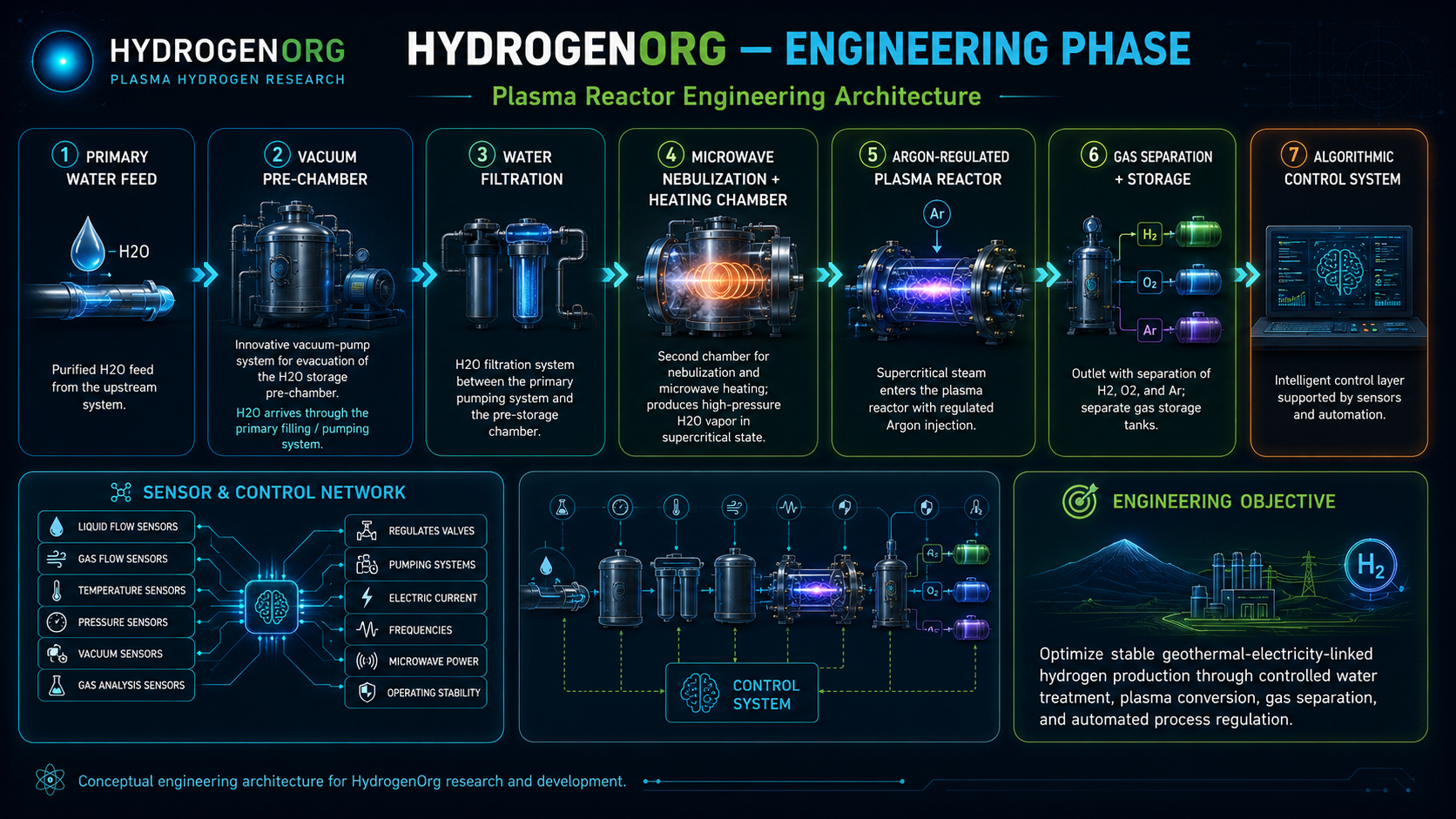
Seven controlled layers for the plasma reactor concept
The engineering phase separates the reactor concept into functional layers. Each layer must be modelled, controlled, measured and validated before any industrial interpretation.
Primary water feed
Purified H₂O arrives from the upstream system through the primary filling and pumping line.
Vacuum pre-chamber
An innovative vacuum-pump system evacuates the H₂O storage pre-chamber before controlled feed operation.
Water filtration
A filtration layer is positioned between the primary pumping system and the H₂O pre-storage chamber.
Microwave heating
A second chamber supports nebulization and microwave heating, producing high-pressure H₂O vapor in a supercritical state.
Argon-regulated plasma
Supercritical steam enters the plasma reactor with regulated Argon injection and controlled plasma parameters.
Gas separation
The reactor outlet is directed toward separation of H₂, O₂ and Ar, followed by separate gas storage.
Algorithmic control
Sensor-driven regulation controls valves, pumping systems, electric current, microwave power, frequencies and stability.
Validation layer
Each operating assumption must be tested through measurements, safety review, gas analysis and reproducible experimental data.
Sensor and algorithmic control network
The reactor concept requires a control layer able to connect liquid flow, gas flow, temperature, pressure, vacuum and gas analysis data to automated regulation.
Sensor inputs
- Liquid flow sensors: control H₂O feed stability and pumping logic.
- Gas flow sensors: monitor Argon injection and outlet gas streams.
- Temperature sensors: track preheating, microwave chamber and plasma-zone temperatures.
- Pressure sensors: supervise high-pressure vapor formation and reactor feed conditions.
- Vacuum sensors: validate evacuation of the storage pre-chamber.
- Gas analysis sensors: measure H₂, O₂, Ar and possible residual species at the outlet.
Controlled outputs
- Valves: regulate feed sequence, Argon injection and separated gas routing.
- Pumping systems: control primary filling, vacuum evacuation and pressure-staged feed.
- Electric current: adjust plasma operating intensity.
- Frequencies: tune microwave and plasma-related control parameters.
- Microwave power: control nebulization and vapor heating energy input.
- Operating stability: maintain safe, repeatable and measurable process conditions.
Engineering objective: controlled validation before deployment.
Optimize stable geothermal-electricity-linked hydrogen production through controlled water treatment, plasma conversion, gas separation and automated process regulation. HydrogenOrg should present this stage as a conceptual engineering architecture, not as a certified industrial reactor.