Open scientific challenges platform
A global collaborative environment where researchers, engineers, simulation designers and AI systems explore unresolved hydrogen, plasma, infrastructure and regenerative civilization challenges.
The objective is to transform complex scientific questions into structured missions, simulations, technical reviews and future validation pathways.
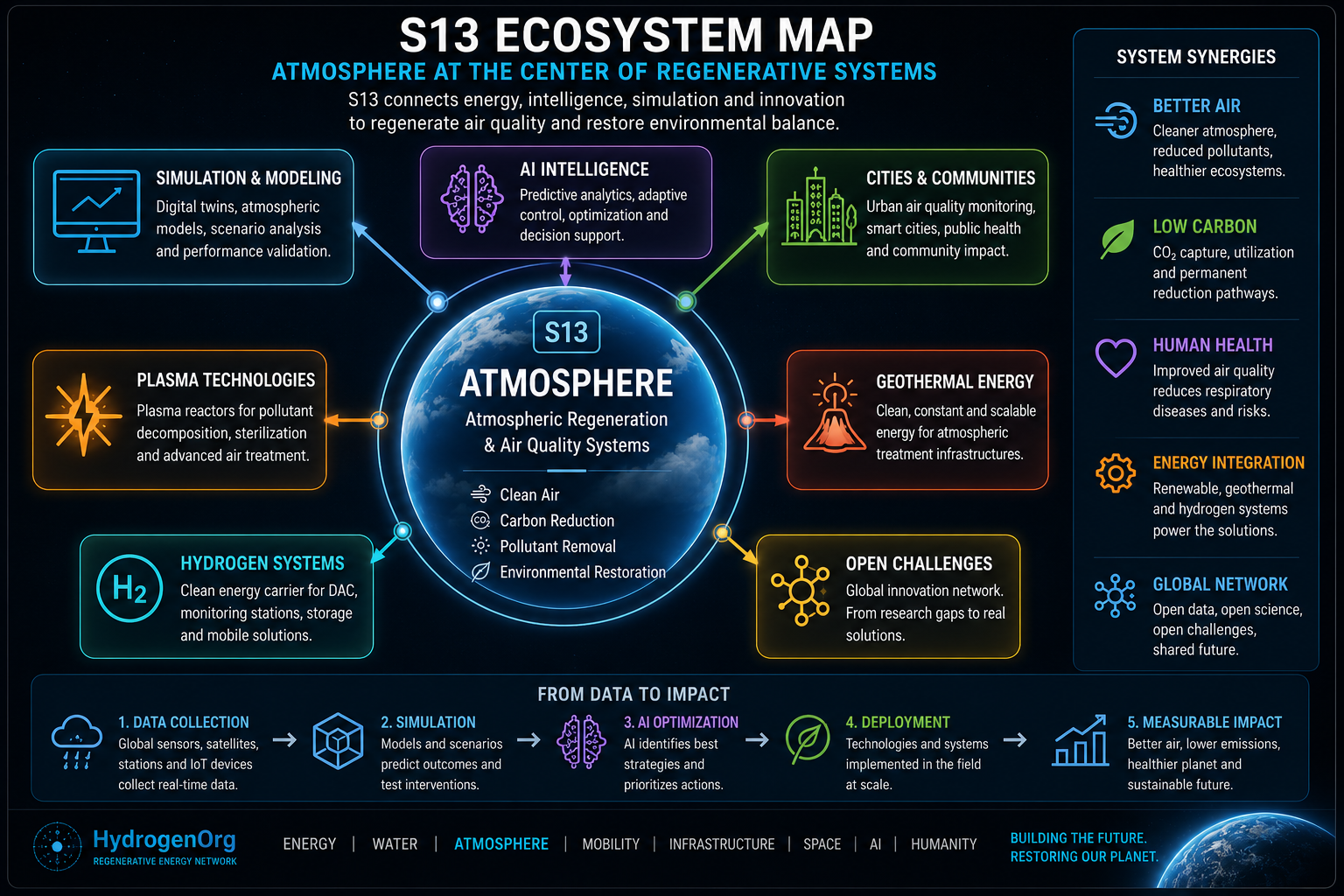
Open challenges for regenerative civilization
HydrogenOrg organizes complex scientific questions into collaborative missions that connect simulation, infrastructure design, AI governance, energy systems and planetary-scale research.
Plasma stability
Investigate plasma confinement stability, thermal buffering, energy balance and reactor survivability concepts.
Explore MissionWater recovery efficiency
Improve regenerative water systems, purification pathways, desalination and autonomous recycling models.
Open ChallengeHydrogen storage networks
Explore distributed hydrogen infrastructure resilience, balancing, transport and emergency storage strategies.
View SystemsGeothermal integration
Investigate geothermal-first and hybrid geothermal-plasma architectures for regenerative energy ecosystems.
Analyze ModelsAI scientific governance
Explore how AI systems could support scientific coordination, risk analysis and infrastructure decisions.
Open Governance LayerOrbital resource systems
Design orbital hydrogen infrastructure, autonomous habitats and future interplanetary logistics concepts.
Launch Orbital ResearchMulti-domain collaboration framework
Challenges are organized into interconnected domains so contributors can identify where their experience, data or technical review may be useful.
Infrastructure missions
Distributed energy, hydrogen storage, transport systems, ports, logistics and resilience architecture.
Planetary systems
Regenerative ecosystems, atmospheric recovery, thermal management, water loops and sustainability.
Orbital expansion
Autonomous habitats, plasma propulsion, orbital hydrogen and extraterrestrial infrastructure.
From scientific question to validation pathway
Every useful challenge should move through a transparent sequence: define the problem, expose assumptions, simulate alternatives, invite expert review and identify the next experiment.
Define
Describe the unresolved scientific or engineering problem clearly.
Model
Establish assumptions, system boundaries, equations and scenarios.
Compare
Evaluate alternative pathways, energy demands, risks and benefits.
Review
Invite researchers, engineers and partners to challenge the model.
Validate
Identify measurements, laboratory work or proof-of-concept requirements.
Join the HydrogenOrg research network
Researchers, engineers, simulation specialists, students, laboratories and technical partners can contribute questions, models, data, review and validation pathways.
Define the problem. Challenge the model. Build the validation path.
HydrogenOrg is built to connect open scientific curiosity with structured simulation, technical review and future proof-of-concept work.