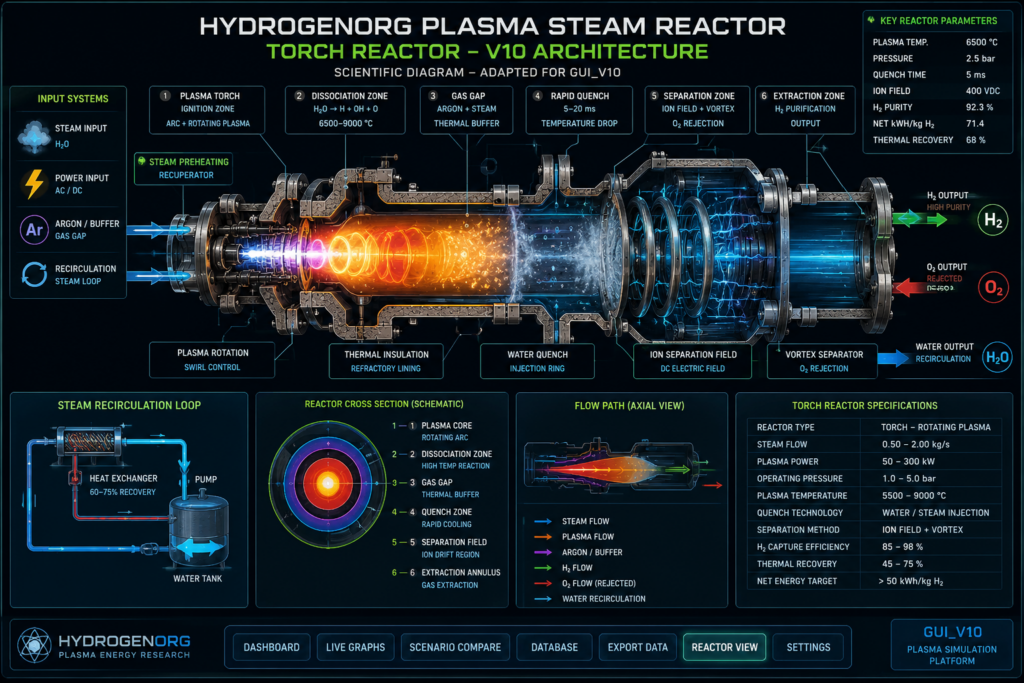
Plasma Steam Reactor Framework
A conceptual research framework for plasma-assisted steam dissociation, hydrogen separation, rapid quenching, thermal recovery and simulation-based reactor architecture.
Plasma-Assisted Hydrogen Research System
S1 defines the primary HydrogenOrg reactor concept: steam enters a high-energy plasma zone, dissociation pathways are explored, and downstream separation, quenching and recovery systems are modeled as one integrated research architecture.
Plasma Torch
High-energy plasma zone for theoretical steam activation and thermal dissociation modeling.
Open Plasma CoreHydrogen Pathway
Conceptual hydrogen capture, purification and separation routes inside a controlled reactor flow.
View ScenariosSteam Dissociation
Research model for water vapor interaction with plasma fields and high-temperature energy zones.
Simulate FlowRapid Quench
Fast cooling concepts for stabilizing reaction products and controlling recombination behavior.
Read DocumentationIon Separation
Electric-field and vortex-assisted separation concepts for hydrogen and oxygen stream management.
Compare ModelsThermal Recovery
Recovery of reactor heat into steam preheating, recirculation and hybrid energy integration.
Explore Hybrid SystemsFrom Steam Input to Hydrogen Output
The S1 framework is organized as a modular research chain: input preparation, plasma activation, dissociation, quench, separation, thermal recovery and scenario validation.
Steam Input
Water vapor enters the system as the primary hydrogen-bearing feedstock.
Plasma Activation
Electrical energy creates a high-temperature plasma environment for theoretical dissociation.
Thermal Buffer
Gas gaps, insulation and controlled flow zones stabilize the reactor environment.
Rapid Cooling
Quench concepts reduce recombination risk and define downstream chemistry assumptions.
Separation Field
Ion-field, vortex and flow-based separation concepts are explored as model layers.
Scenario Archive
Parameters, assumptions and results are stored in the HydrogenOrg simulation database.
Conceptual Reactor Variables
These parameters are not presented as validated engineering specifications. They are research variables for simulation, comparison and technical discussion.
Plasma Temperature
High-temperature operating assumptions for dissociation-zone scenario modeling.
Pressure Range
Controlled pressure assumptions for flow stability and reactor architecture comparison.
Quench Time
Rapid cooling time as a key control variable for downstream product behavior.
Ion Field
Electric-field assumptions for conceptual ion drift and stream separation studies.
Recovery Rate
Thermal recovery estimates used for scenario comparison and system efficiency modeling.
Energy Target
Net energy assumptions used to evaluate whether a scenario is worth further research.
S1 as the Foundation of the HydrogenOrg Ecosystem
The plasma reactor framework connects directly to water regeneration, geothermal hybrid systems, open simulation, AI governance and future infrastructure networks.