Geothermal DesalinationEngineering System
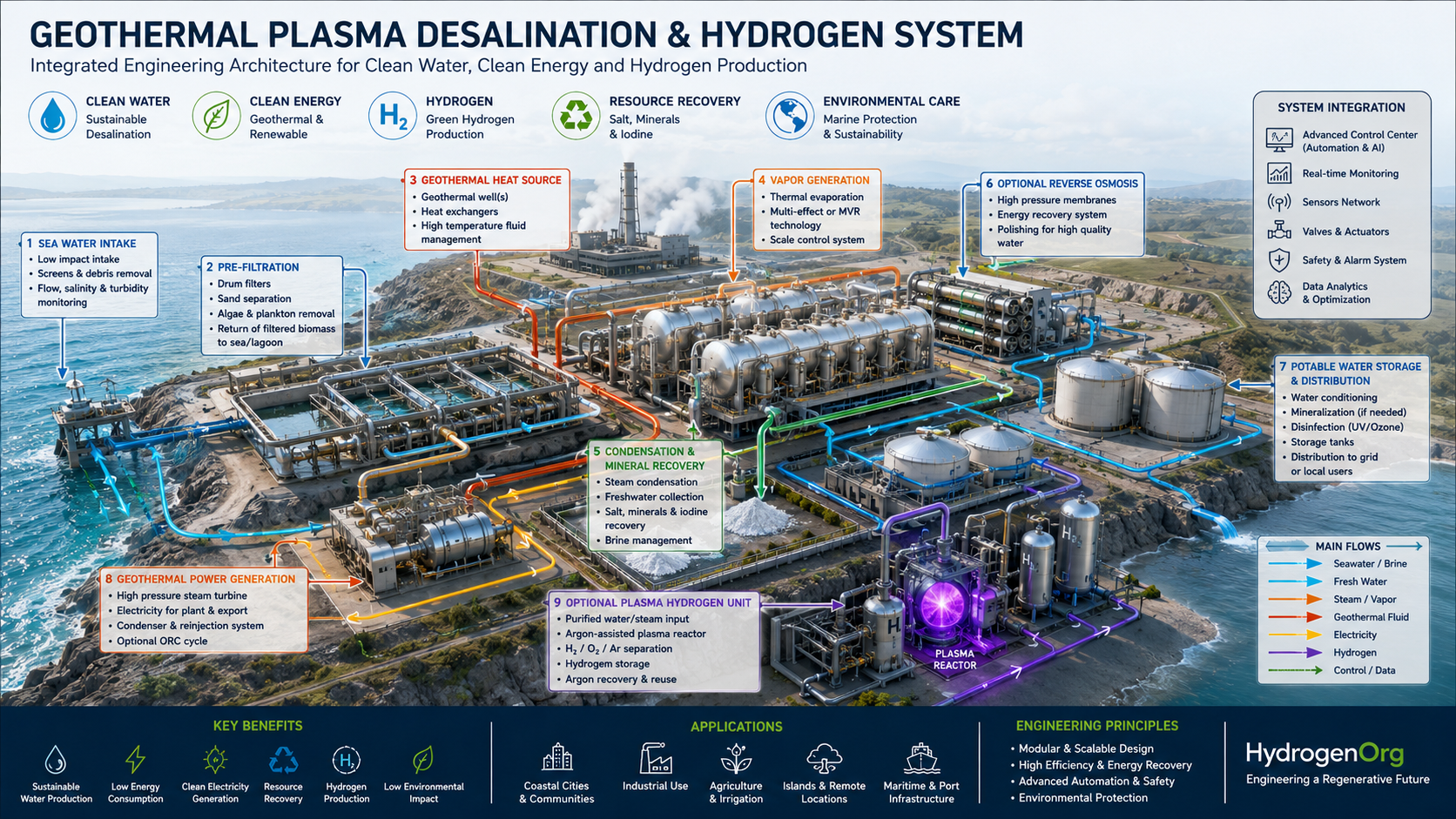
A modular engineering concept combining seawater intake, biological pre-filtration, geothermal vapor condensation, optional reverse osmosis, salt and mineral recovery, potable-water storage, geothermal electricity and optional plasma hydrogen production in one integrated infrastructure model.
Project Vision
HydrogenOrg is developing a conceptual engineering framework for coastal regions, islands, ports, lagoons and industrial sites where water scarcity, energy cost and environmental constraints must be solved together.
The system begins with controlled intake of seawater, brackish water or lagoon water, followed by mechanical and biological pre-filtration, geothermal vapor generation, condensation, optional reverse osmosis and final potable-water conditioning.
The platform also studies recovery of salt, iodine and selected minerals from brine, geothermal electricity generation through turbine or ORC concepts, and an optional plasma-hydrogen research module connected to purified water or steam streams.
Integrated Energy
Geothermal heat, optional turbine generation and auxiliary renewable support in one engineering model.
Circular Resources
Fresh water output, brine concentration, salt recovery and mineral stream assessment.
Lower Impact
Designed to reduce grid dependence, unmanaged brine discharge and environmental burden.
Engineering Simulation
Scenario comparison, transparent assumptions, KPI dashboards and CSV export.
System Architecture
From Seawater to Potable Water, Energy and Hydrogen Readiness
The project is organized as a modular engineering chain. Each component can be simulated independently or combined into a complete desalination, geothermal-energy, resource-recovery and hydrogen-readiness scenario.
Water Intake
Controlled intake from seawater, oceanic, brackish, basin or lagoon sources with low-impact flow management.
Pre-Filtration
Removal of particles, sand, algae, plankton and biological material before thermal or membrane treatment.
Geothermal Vapor Core
Subsurface heat supports vapor generation, condensation and reduced dependency on external electricity.
Reverse Osmosis Option
Optional membrane layer for polishing or additional desalination when final water quality requires it.
Salt & Mineral Recovery
Brine concentration and controlled recovery of salt, iodine and selected mineral streams.
Potable Water Storage
Conditioning, remineralization, sterilization, tank storage and controlled injection into the water network.
Geothermal Power
Steam turbine or ORC generation can supply the plant and, in optimized scenarios, export electricity to the grid.
Plasma Hydrogen Option
Optional research module using purified water or steam with Argon-assisted plasma and gas separation.
Command Center
Algorithmic supervision of sensors, valves, pumps, pressure, temperature, flows, gas analysis and safety states.
Command & Control
Central Process Control for Water, Heat, Energy and Gas Streams
The engineering model requires a control center able to coordinate seawater intake, filtration, geothermal heat exchange, vapor condensation, reverse osmosis, storage, turbines, optional plasma hydrogen and environmental monitoring.
Water pressure, vapor pressure, geothermal temperature, evaporator temperature, condenser status and turbine stability.
Seawater, potable water, brine, geothermal fluid, Argon, hydrogen, oxygen and recovered gas flow monitoring.
Salinity, pH, conductivity, turbidity, biological indicators, mineral concentration and final potable-water validation.
Automated regulation of pumps, valves, safety closures, membrane pressure, geothermal exchange and optional plasma operation.
Engineering Deployment
Personnel, Safety and Infrastructure Requirements
A practical plant would require multidisciplinary engineering review, environmental assessment and operational planning before any industrial interpretation.
Engineering Team
Geothermal, hydraulic, chemical, membrane, electrical, turbine, safety and process-control engineers.
Analysis Laboratories
Water quality, brine chemistry, mineral composition, gas analysis, biological monitoring and validation protocols.
Plant Infrastructure
Intake, filtration basins, geothermal module, condensers, RO units, tanks, electrical room, control room and maintenance area.
Key Benefits
Why This Project Matters
This project connects clean water, low-cost energy, resource recovery and resilient infrastructure into one regenerative research pathway.
Low Energy Cost
Geothermal heat and solar support can reduce dependency on expensive grid electricity.
Low Environmental Impact
Reduced energy pressure, cleaner brine handling and circular-resource logic.
Fresh Water Production
Conceptual architecture for reliable clean-water output in coastal or dry regions.
Salt Recovery
Recovered industrial salt can become a usable resource instead of unmanaged waste.
Scalable Infrastructure
Modular plant concepts can be adapted to islands, ports, industrial sites and communities.
Research & Simulation
Open modelling helps compare assumptions, costs, recovery paths and environmental indicators.
Salt, Iodine & Mineral Recovery
Turning Brine into a Managed Resource Stream
Brine management is one of the key environmental challenges of desalination. HydrogenOrg models brine as a managed stream for controlled concentration, potential salt, iodine and mineral recovery, storage and regulated disposal.
Reduce brine volume through controlled concentration and heat integration.
Separate recoverable salts and minerals through solid-liquid processing.
Create usable industrial salt streams for storage, logistics and potential reuse.
Store dry salt in silos, containers or modular storage units with controlled handling.
Simulation Layer
Open Scenario Modelling
The V1.0 simulator estimates fresh water output, final salinity, brine concentration, salt and mineral recovery, geothermal electricity generation, optional reverse osmosis, optional plasma hydrogen, control readiness, safety indicators and economic performance.
Scenario Export
Download scenario results as CSV for documentation and comparison.
Impact Indicators
Estimate avoided emissions and environmental performance indicators.
Hydrogen Integration
Evaluate how geothermal and plasma inputs may connect to hydrogen infrastructure.
Open Simulator ->Engineer the Next Geothermal Water Infrastructure Layer
Join HydrogenOrg in building open engineering tools for clean water, geothermal energy, resource recovery, maritime infrastructure and optional hydrogen production.
Important Engineering Note
Conceptual Research Architecture, Not a Construction Manual
This page describes a conceptual engineering architecture for research, simulation and feasibility analysis. It is not a certified desalination plant design, construction manual, environmental permit, safety certification or industrial guarantee. Any practical implementation requires independent engineering review, hydrogeological analysis, marine environmental assessment, water quality validation, legal review, safety assessment and regulatory approval.