Marine Hybrid Electric Closed-Loop Plasma-H₂ System
A new marine propulsion research architecture moving beyond the conventional engine model toward a hybrid-electric vessel powered by a closed-loop plasma-H₂ reactor, fuel cells, ORC/steam turbine recovery, batteries and electric propulsion.
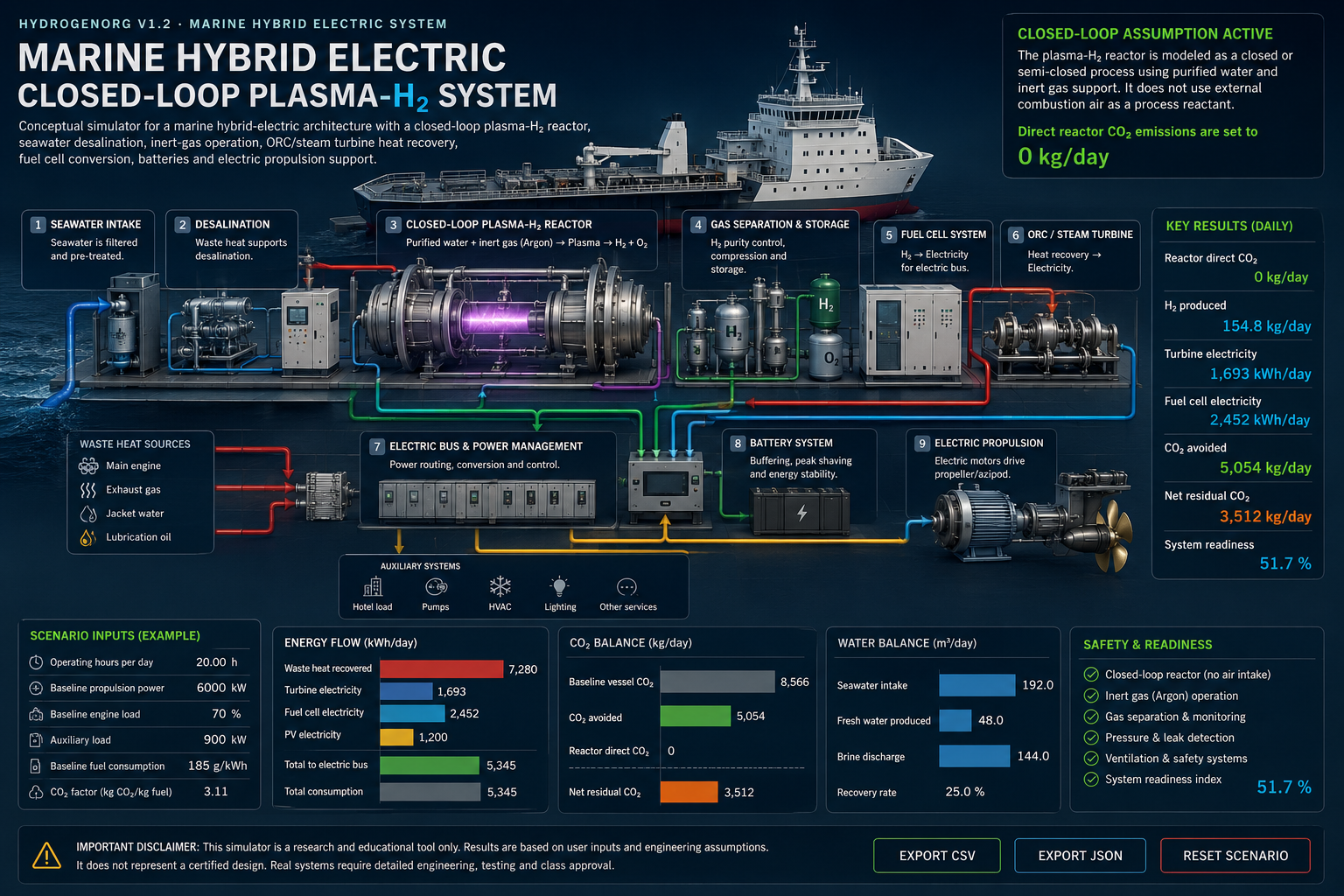
Why the propulsion concept changed
The first marine model evaluated a vessel where a conventional marine engine remained the main reference system and the plasma-H₂ layer was considered mainly as an auxiliary support module.
The V1.2 architecture changes the system boundary. The vessel is now modeled as a hybrid-electric marine platform. Propulsion is no longer centered on a traditional engine alone, but on an integrated electrical bus supplied by a closed-loop plasma-H₂ reactor, fuel-cell conversion, turbine heat recovery and battery buffering.
This approach is more coherent with marine operation because ships run for many hours at stable loads, have space for technical modules and can integrate seawater intake, desalination, heat recovery, gas handling and electric propulsion more realistically than smaller vehicles.
Architecture transition
Conventional marine engine as baseline, with plasma-H₂ and fuel-cell support treated mainly as auxiliary reduction layers.
Hybrid-electric vessel architecture with closed-loop plasma-H₂ reactor, fuel cell, ORC/steam turbine, battery buffering and electric propulsion.
Closed-loop reactor
Purified water and inert gas support replace external combustion-air dependency.
Fuel cell conversion
Hydrogen is converted into electricity for the vessel’s electric bus.
Turbine recovery
Waste heat and thermal output are routed to ORC or steam turbine generation.
Electric propulsion
Batteries and power electronics feed electric propulsion and auxiliary systems.
New Propulsion Architecture
From Marine Fuel Engine to Hybrid Electric Plasma-H₂ Propulsion
The V1.2 concept treats the vessel as a coordinated energy platform. The main objective is to explore whether hydrogen, heat recovery and electric propulsion can work together in one controlled onboard architecture.
Seawater and purified water
Seawater intake and desalination provide purified water for the closed-loop plasma-H₂ process, while brine and mineral streams remain part of the engineering balance.
Closed-loop plasma-H₂ reactor
The reactor is modeled as a closed or semi-closed system using purified water and inert gas support. It does not use external combustion air as a process reactant.
Gas separation and storage
Hydrogen and oxygen streams require separation, monitoring, pressure control, storage logic and safety systems before any energy conversion step.
Fuel cell electric output
Hydrogen feeds a fuel-cell layer to generate electricity for the DC/electric bus, reducing the need for conventional generator operation.
ORC / steam turbine recovery
Heat from onboard sources and reactor thermal output can be routed to ORC or steam turbine recovery to generate additional electricity.
Electric propulsion and batteries
Batteries stabilize the electrical bus, support peak loads and feed electric propulsion motors, pumps, hotel loads and other onboard services.
Energy Flow
Integrated Marine Energy Chain
The new model is based on a chain of conversions rather than one isolated engine. Hydrogen, heat and electricity are connected through controlled subsystems.
Seawater is filtered and converted into purified process water.
The closed-loop plasma-H₂ reactor produces hydrogen under controlled assumptions.
Useful heat is routed to ORC or steam turbine generation instead of being wasted.
Fuel cells and turbine recovery feed the onboard electric bus.
Batteries and power electronics support electric motors and auxiliary systems.
Corrected CO₂ logic
In this V1.2 model, the closed-loop plasma-H₂ reactor is not treated as a combustion engine. It is modeled as a closed or semi-closed process using purified water and inert gas support. Therefore, direct reactor CO₂ emissions are set to zero in the conceptual simulation.
Remaining CO₂ values refer to the conventional vessel baseline, backup fuel use or residual fossil energy still required after fuel-cell, turbine, PV and battery contributions.
V1.2 Simulation Layer
What the new simulator evaluates
The V1.2 simulator estimates the interaction between closed-loop hydrogen production, heat recovery, turbine generation, fuel-cell electricity, batteries and propulsion demand.
Hydrogen production
Estimates hydrogen output from the plasma-H₂ layer using water, energy, duty cycle, inert gas and conversion assumptions.
Turbine electricity
Calculates electricity recovered from heat using ORC or steam turbine efficiency assumptions.
Fuel-cell output
Converts hydrogen into usable electric power for the vessel’s DC/electric bus.
Battery buffering
Evaluates battery capacity, usable state of charge, peak shaving and energy stability.
Electric propulsion
Compares available electric energy with propulsion and auxiliary demand.
Residual emissions
Separates baseline vessel CO₂, avoided CO₂, net residual CO₂ and direct reactor CO₂.
Open V1.2 Simulator ->Scientific limits and safety scope
This system is a research and simulation model. It is not presented as a certified marine propulsion system or an industrial-ready design.
- The system does not claim free energy and does not assume energy recovery without physical cost.
- The closed-loop plasma-H₂ reactor requires laboratory validation of efficiency, durability, gas purity and safety.
- Hydrogen storage, pressure control, ventilation, leak detection and fire-safety systems are critical marine requirements.
- ORC or steam turbine recovery depends on real heat availability, temperature level, turbine efficiency and marine integration constraints.
- Electric propulsion requires power electronics, redundancy, classification review and regulatory approval.
- The simulator supports engineering discussion; it does not replace laboratory testing or marine certification.
Explore the V1.2 Marine Hybrid Electric Model
Open the public simulator to test closed-loop plasma-H₂ assumptions, fuel-cell electricity, ORC/steam turbine recovery, battery buffering, electric propulsion demand and corrected CO₂ logic.