Cleaner air. Regenerative infrastructure.
HydrogenOrg explores how plasma treatment, carbon capture, catalytic systems, geothermal energy, hydrogen infrastructure, sensors and AI can work together to reduce atmospheric pollution and support measurable environmental recovery.
The objective is not only to reduce emissions, but to design systems that actively improve air quality.
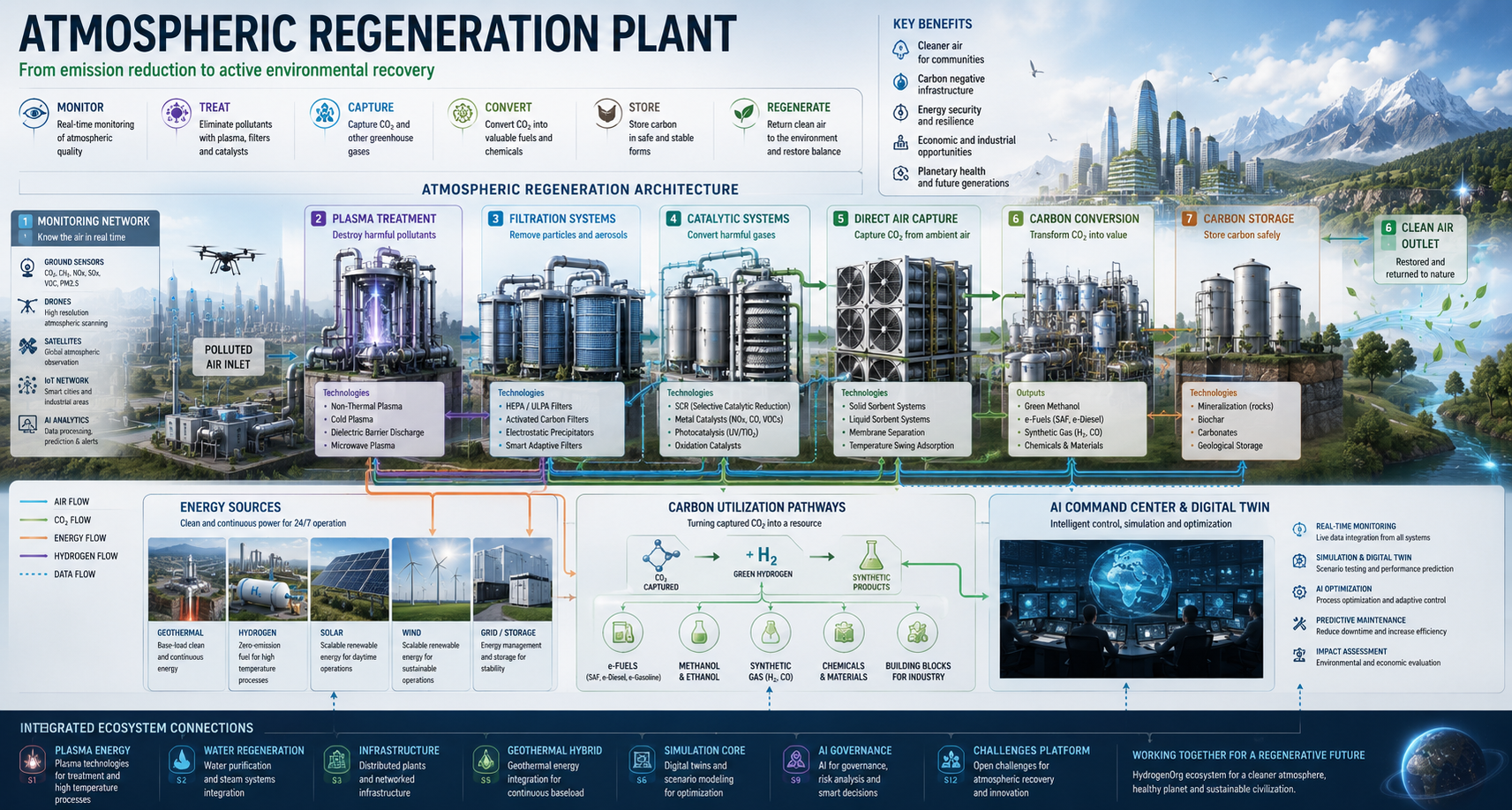
From polluted air to regenerative infrastructure
The architecture combines monitoring, plasma processing, catalytic treatment, filtration, carbon conversion, geothermal and renewable energy, hydrogen pathways and AI coordination in one integrated environmental recovery system.
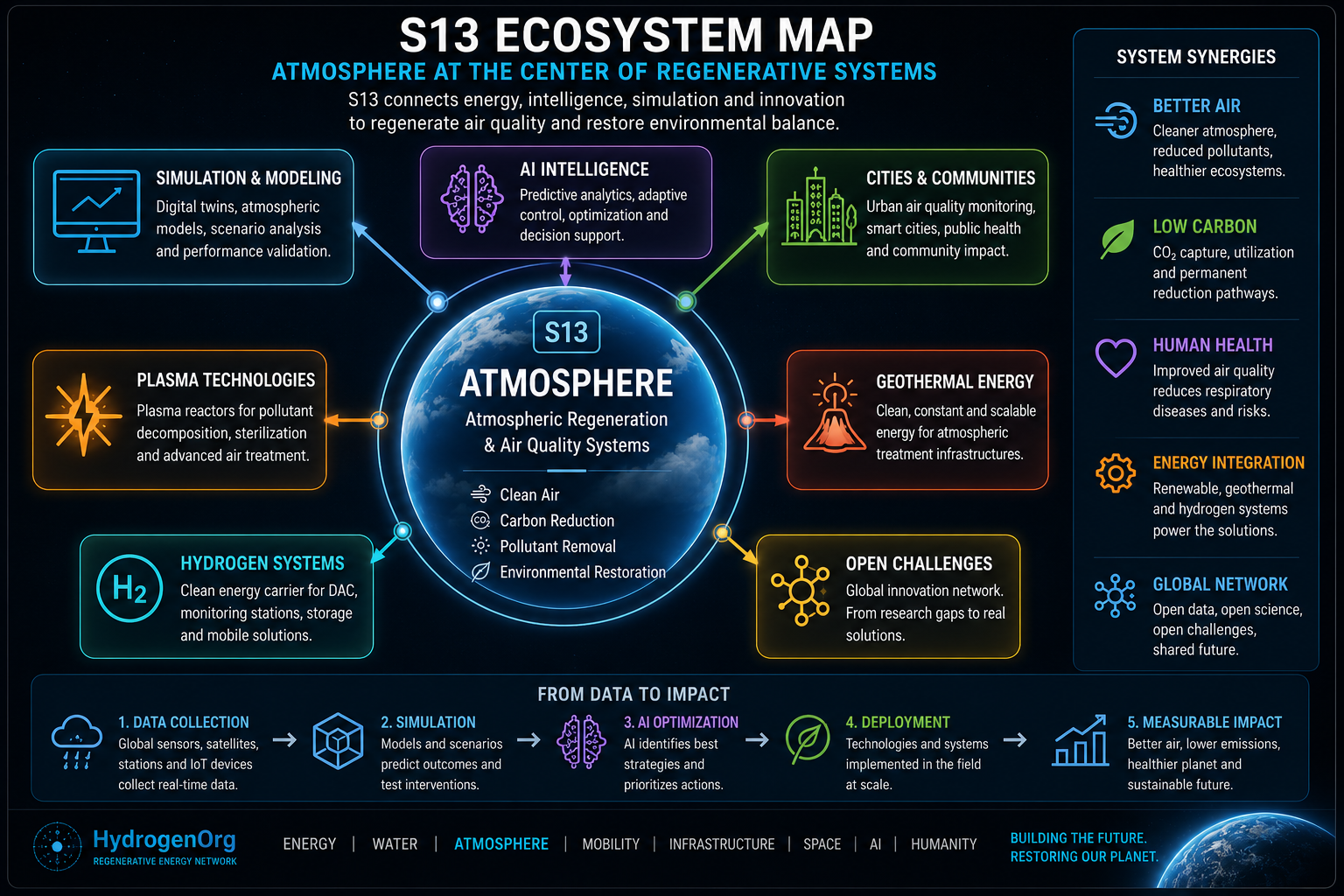
S13 ecosystem map
Atmosphere connects Simulation, AI, Plasma, Geothermal, Hydrogen, Cities, Infrastructure and Open Challenges into a unified research ecosystem.
Why atmospheric regeneration matters
Atmospheric recovery requires more than one device. It requires a coordinated system that identifies pollutant sources, selects treatment pathways, supplies clean energy, manages recovered materials and verifies real environmental improvement.
Carbon recovery
Explore direct air capture, mineralization, biochar, biomass systems and carbon-negative infrastructure pathways.
Toxic compound reduction
Investigate removal or conversion of NOx, SOx, VOCs, methane and industrial air pollutants.
Atmospheric intelligence
Use monitoring, digital twins and AI governance to map pollution sources, rank interventions and verify outcomes.
Track the atmospheric recovery pipeline
These indicators define the present research structure and can later be connected to real projects, simulations, measurements and partner validation.
Monitoring, DAC, plasma, mineralization, biochar, algae, hydrogen and digital twins.
CO2, CH4, NOx, SOx, VOCs and particulate matter.
Technical problems for capture, treatment, energy and verification.
The environmental outcome layer of the HydrogenOrg research ecosystem.
A research platform for atmospheric recovery
The platform turns a broad environmental objective into concrete research actions: map pollutants, compare technologies, build models, connect energy and submit projects.
Map pollutants
Define target compounds, sources, regions, industrial processes and monitoring requirements.
Task: identify the pollutant flow
Choose a technology
Compare DAC, plasma, mineralization, biochar, filtration, catalysts and biological systems.
Task: select a pathway
Build a model
Create a scenario for energy input, removal rate, cost, durability and environmental benefit.
Task: simulate performance
Connect clean energy
Use geothermal, hydrogen, renewables or recovered heat to power recovery systems.
Task: define energy supply
Close the loop
Plan mineralization, reuse, conversion, storage or biological fixation after capture.
Task: define material destination
Submit a project
Propose a location, pollutant, technology pathway, energy source and first measurable target.
S13 atmospheric work packages
Each work package is designed as a practical action area for contributors, universities, laboratories, engineers and industrial partners.
Atmospheric monitoring
Sensor networks for CO2, methane, NOx, SOx, particulate matter, VOCs and urban air quality.
Map sensor strategy
Direct air capture
Study sorbents, contactors, thermal regeneration, energy demand and geothermal-powered DAC.
Compare DAC concepts
Plasma air treatment
Explore non-thermal plasma, VOC destruction, NOx conversion and industrial exhaust treatment.
Define plasma case
Carbon mineralization
Convert captured CO2 into stable carbonate materials through geological or engineered pathways.
Define storage route
Biochar systems
Use biomass conversion to store carbon, improve soils and connect agriculture with recovery.
Map biomass source
Biological capture
Study algae, photobioreactors, biomass production and biological carbon fixation.
Propose bio-loop
Hydrogen and e-fuels
Use captured carbon with clean hydrogen to explore methanol, e-fuels and circular chemistry.
Estimate hydrogen demand
Atmospheric digital twin
Create regional models for emissions, removal capacity, energy inputs and recovery scenarios.
Build simulation layer
Urban regeneration
Integrate buildings, mobility, vegetation, heat systems and carbon removal in cities.
Define city pilot
Measure, power, capture, convert, verify
Atmospheric regeneration is a complete chain connecting monitoring, clean energy, treatment, material management and long-term verification.
Measure
Identify pollutants, sources, concentration levels and regional exposure patterns.
Power
Connect systems to geothermal, hydrogen, renewables or recovered industrial heat.
Capture
Remove carbon or toxic compounds using physical, chemical, biological or plasma pathways.
Convert / Store
Mineralize, reuse, transform or permanently store recovered material.
Verify
Use monitoring and digital twins to evaluate real environmental improvement.
Measure, simulate, coordinate, verify
The Digital Twin connects sensors, models, AI coordination and infrastructure to evaluate whether the proposed system actually improves air quality.
Sensors
Collect data for CO2, CH4, NOx, SOx, VOCs, PM2.5 and regional air quality.
Simulation
Model pollutant flows, capture rates, energy demand and treatment capacity.
AI coordination
Rank interventions, compare risks and optimize energy and recovery pathways.
Infrastructure
Connect plasma, DAC, filters, catalysts, geothermal and hydrogen systems.
Verified impact
Measure whether pollutants decrease and environmental quality improves.
Atmospheric command layer
Each project defines one target pollutant, one system boundary, one energy source, one treatment pathway and one verification metric.
Atmospheric problems worth solving
Each challenge can become a simulation case, student project, laboratory study, partner collaboration or technical discussion.
Low-energy carbon capture
Reduce DAC energy demand through sorbent design, geothermal heat and waste-heat integration.
Plasma VOC destruction
Assess plasma systems for volatile organic compounds, odors and industrial gas treatment.
Atmospheric digital twin
Create a model connecting sensors, pollutants, treatment units, energy and verified outcomes.
Geothermal-powered DAC
Study continuous geothermal energy for capture, regeneration and mineralization pathways.
Hydrogen carbon utilization
Use recovered CO2 and clean hydrogen to explore methanol, e-fuels and circular chemistry.
Urban air recovery network
Combine sensors, filters, vegetation, mobility, plasma units and AI monitoring at city scale.
S13 connects the HydrogenOrg ecosystem
Atmospheric regeneration connects energy, hydrogen, infrastructure, cities, simulation and AI into one environmental recovery mission.
Geothermal power
Continuous energy and heat for DAC, regeneration and mineralization.
Infrastructure networks
Capture, hydrogen, storage, sensors and regional planning.
Submit an atmospheric regeneration brief
Define one pollutant, one location, one technology pathway, one energy source and one measurable environmental target.
Reduce pollution. Verify recovery. Build regenerative systems.
HydrogenOrg invites researchers, engineers, laboratories, cities and technical partners to help transform atmospheric recovery concepts into measurable and validated infrastructure.