Geothermal Plasma Desalination System.
HydrogenOrg is exploring geothermal-assisted desalination, plasma thermal enhancement, brine recovery and salt logistics as an early-stage research and simulation direction for regenerative water infrastructure.
This is not an industrial claim. The objective is to build an open modelling, validation and partnership pathway toward clean water, low-cost heat, resource recovery and future pilot systems.
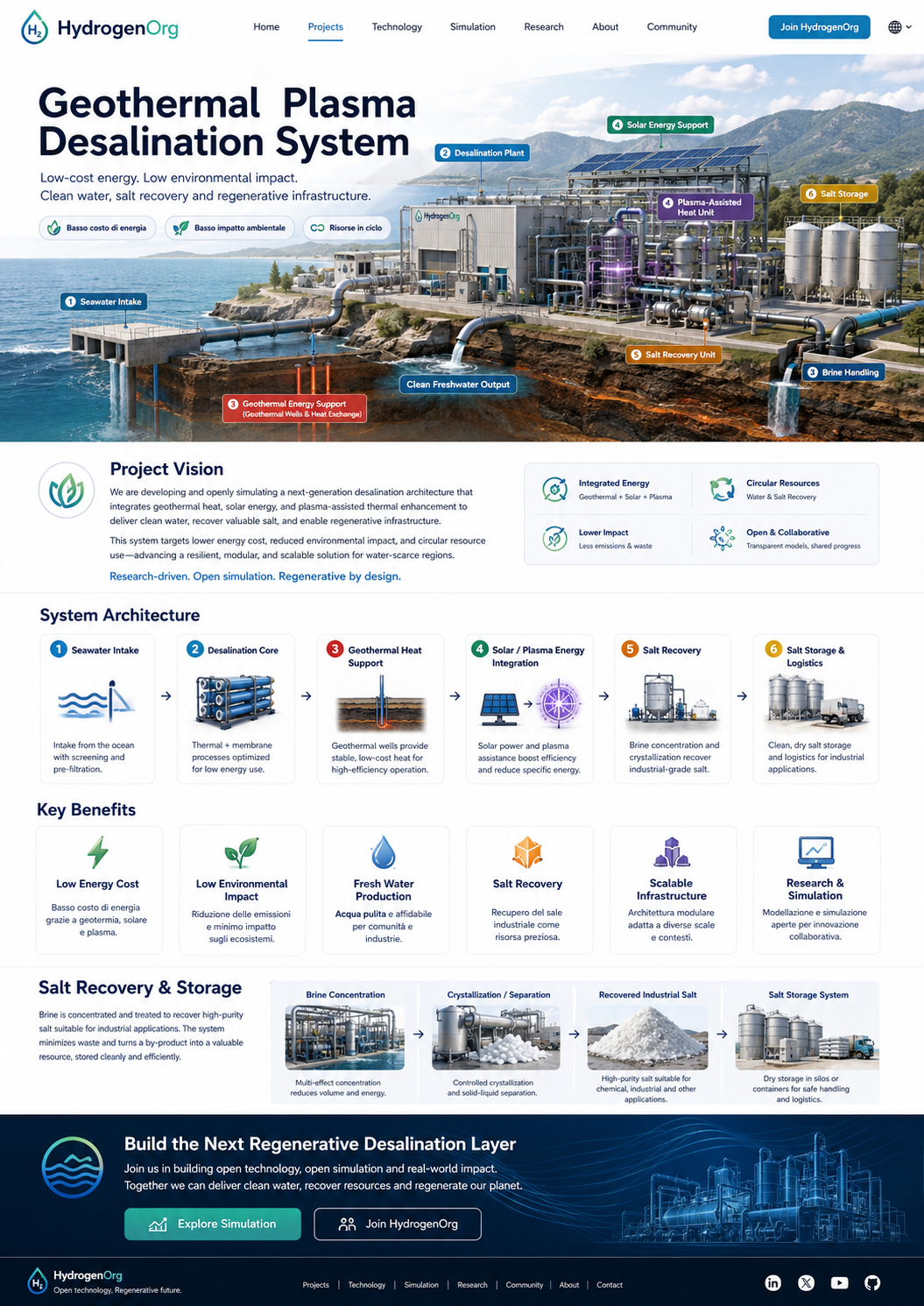
Desalination Should Become Regenerative Infrastructure.
Desalination is often treated only as a water-production process. HydrogenOrg explores whether desalination can also become a regenerative infrastructure system that connects clean water, low-cost energy, brine management, salt recovery and open modelling.
Clean Water
Explore scenarios for fresh water output under different thermal, energy and recovery assumptions.
Low-Cost Heat
Evaluate geothermal baseline heat and solar support as possible energy layers in suitable regions.
Brine Recovery
Study concentrated brine not only as waste, but as a potential mineral recovery and logistics stream.
Open Modelling
Use transparent simulations to compare assumptions before expensive prototype or pilot decisions are made.
Geothermal Heat, Solar Support, Plasma Enhancement and Salt Recovery.
The project combines multiple layers into one conceptual architecture. Each layer must be modelled, reviewed and validated before any industrial claim can be made.
Core architecture
The system concept begins with seawater or brackish water input, then explores how geothermal baseline heat and solar support could reduce external energy demand.
Plasma-assisted thermal enhancement is treated as a research layer for possible process intensification, brine treatment or evaporation support.
Concentrated brine is then studied as a recoverable salt stream, not only as a disposal problem.
Geothermal Baseline
Stable thermal foundation in suitable regions, depending on local geology, temperature and infrastructure.
Solar Support
Auxiliary support for pumping, preheating, control systems and hybrid energy balancing.
Plasma Layer
Research hypothesis for thermal enhancement, process acceleration or brine treatment scenarios.
Salt Recovery
Recovered salt streams, modular storage and logistics as part of a regenerative resource model.
What the First Model Should Compare.
The first HydrogenOrg model should be simple, transparent and editable. It should not prove the technology. It should expose assumptions, identify constraints and guide technical review.
Input Parameters
Feed water volume, salinity, recovery ratio, geothermal heat available, solar support, plasma energy input, energy cost and CO₂ intensity.
Output Indicators
Clean water output, remaining brine volume, salt recovery potential, external energy demand, heat offset and estimated CO₂ impact.
Warnings & Limits
Energy gaps, unstable assumptions, missing data, brine disposal risks, environmental limits and feasibility warnings.
What Needs to Be Tested Before Deployment.
Plasma Desalination Systems should be treated as a structured research pathway. The first objective is not to sell a system, but to define what must be proven.
Energy Cost
Can geothermal baseline heat reduce desalination energy cost in suitable regions?
Plasma Value
Can plasma-assisted enhancement improve a specific part of the process without adding excessive energy cost?
Brine Management
Can concentrated brine become a recoverable resource stream instead of only an environmental burden?
Salt Logistics
Can recovered salts be stored, transported or reused in a way that creates practical value?
Pilot Regions
Which islands, ports, geothermal regions or industrial sites could become suitable pilot contexts?
Open Validation
Can open modelling help attract technical reviewers, partners and funders before prototype investment?
This Project Requires a Technical and Financial Ecosystem.
HydrogenOrg is looking for serious contributors who can help review, model, validate and eventually prepare pilot pathways.
Water Experts
Desalination engineers, brine specialists, membrane experts, water treatment researchers and environmental reviewers.
Join as ContributorEnergy Experts
Geothermal, solar, thermal systems and plasma technology experts able to review assumptions and constraints.
Contribute ExpertiseIndustrial Partners
Component suppliers, engineering firms, port operators, island systems and industrial sites interested in pilot pathways.
Partner PathwayFunding Partners
Grant providers, foundations, impact investors, sponsors and early funders supporting validation and pilot preparation.
Funding PathwaysFrom Concept to Pilot Pathway.
The project should move through clear stages: open definition, simulation, expert review, scenario comparison, modular architecture and future pilot preparation.
Open Research Definition
Define assumptions, system boundaries, terminology, risks and core research questions.
Simulation v0.1
Build the first open model for water output, energy input, brine concentration, salt recovery and CO₂ impact.
Expert Review
Invite engineers and researchers to review the model, identify weak points and improve assumptions.
Prototype Architecture
Develop modular block diagrams for energy flow, water flow, salt recovery and control logic.
Pilot Pathway
Identify partners, sites, funding structures and the possible future deployment vehicle.
Open Research Layer. Future Deployment Layer.
HydrogenOrg is the open research layer. Future companies and pilot vehicles are the deployment layer. Plasma Desalination Systems is a concrete research direction where this logic can be tested.
Open Simulation Infrastructure
Explore the digital layer where HydrogenOrg models geothermal, plasma, water and infrastructure scenarios.
Partners & Funders
Use this pathway for strategic partnerships, pilot development, funding and future deployment vehicles.
Join HydrogenOrg
Submit a request as a technical contributor, founding member, research partner or supporter.
Contact HydrogenOrg
Contact HydrogenOrg for technical review, partnership, funding or institutional discussions.
Help Build the Open Model for Regenerative Desalination.
Plasma Desalination Systems is an early-stage research direction. HydrogenOrg is looking for technical contributors, partners and funders who can help move this concept from open modelling to validation, pilot pathways and future deployment vehicles.