Plasma + Hydrogen
for Rail.
A dedicated research environment for hydrogen rail propulsion, plasma-assisted hydrogen production, thermal recovery, fuel-cell/battery hybridization and industrial system integration.
A measurable pathway, not a performance claim.
Rail is a demanding systems-integration case: energy density, refuelling, mission reliability, thermal management, hybrid power flow and safety must work together. HPRS Rail turns these questions into explicit engineering assumptions that can be challenged and validated with an industrial partner.
Real Mission
Route length, train mass, speed, stops, gradients, auxiliaries and regenerative braking define the actual rail duty.
Hydrogen Chain
Hydrogen demand, fuel-cell efficiency, onboard storage, battery buffering and daily range are kept visible.
Plasma Validation
The simulator asks whether reactor electricity, heat recovery and H₂ recovery can reach a physically and economically meaningful region.
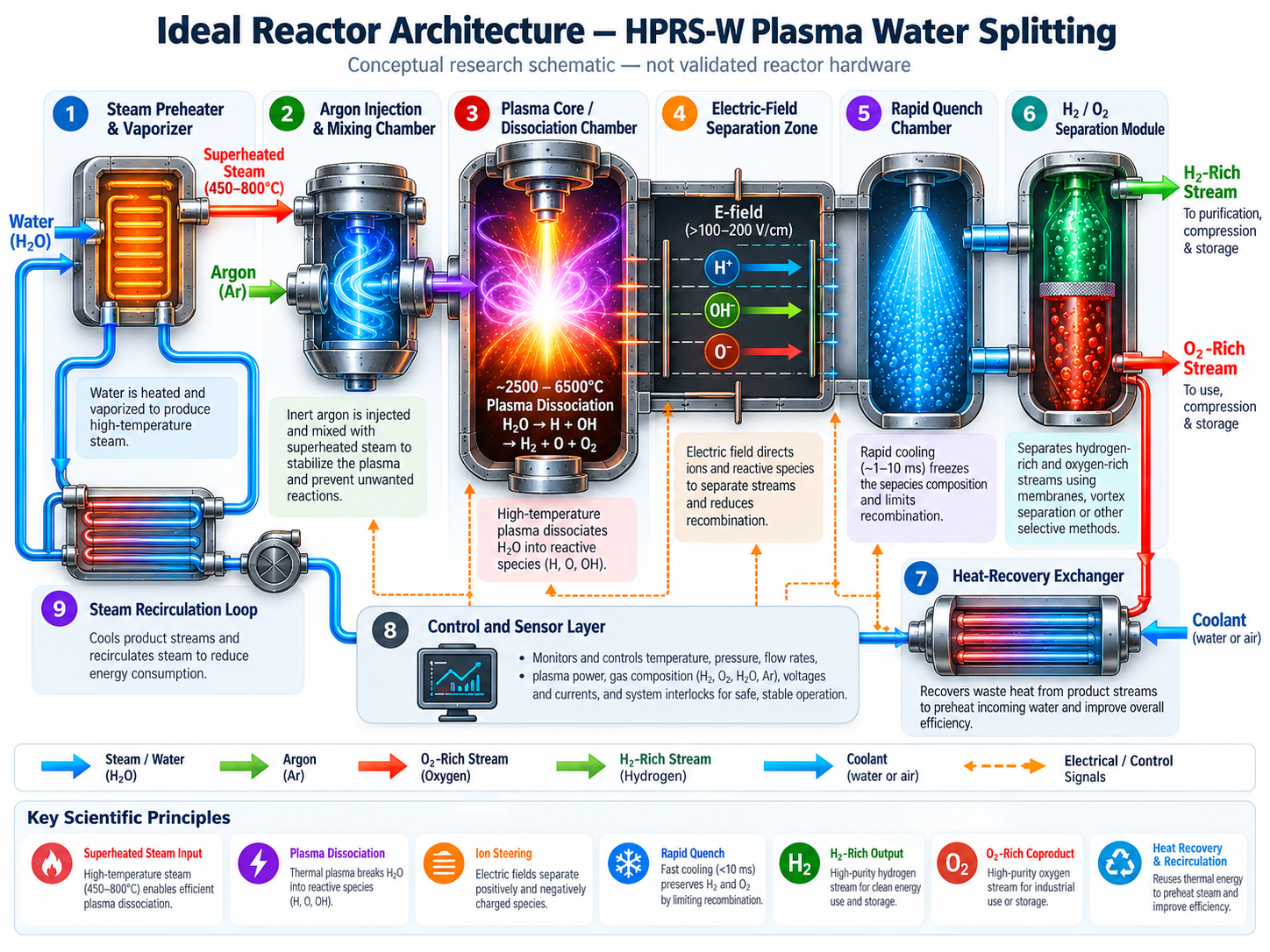
From water to H₂ — with the energy balance kept visible.
The HPRS-W concept uses superheated steam, plasma dissociation, rapid quench, heat recovery and an experimental charged-species steering stage as a research architecture.
- Reversible and thermoneutral energy limits are shown explicitly.
- Plasma electricity and external heat remain user-selected assumptions.
- H₂/O₂ separation and recombination control require experimental validation.
- Onboard self-powering is tested rather than assumed.
HPRS Rail · Simulator V3.5.6
Compare direct electric traction, delivered hydrogen and depot HPRS-W for the same rail mission. V3.5.6 adds PV surface optimization, transparent amortization, the sub-CHF 9.90 target finder and the multi-target Economic Frontier for CHF/kg cost scenarios.
The simulator separates public rail context from editable scenario assumptions. V3.5.6 economic targets are screening results, not guaranteed market prices. Public train figures are contextual guideposts only and are not used to infer proprietary vehicle mass, H₂ storage, fuel-cell rating, battery capacity or confidential duty-cycle data.
What a Rail OEM can contribute.
The objective is not to ask an industrial partner to accept the model. The objective is to replace assumptions with real mission, interface and test data and then make a transparent Go / No-Go decision.
A · Real Rail Mission
Route profile, timetable, vehicle mass, auxiliaries, braking energy and seasonal HVAC requirements.
B · PowerPack Interface
Fuel-cell/battery power flow, H₂ pressure level, buffer strategy, transient requirements and thermal integration.
C · Go / No-Go Test
Measured reactor kWh/kg H₂, purity, recovery, quench behaviour, durability, maintenance and safety.
Define the test together.
HydrogenOrg is seeking a rail-industry partner to convert the HPRS Rail model into a controlled engineering programme: real mission data, measured reactor performance, interface definition and a staged prototype pathway.
 English
 Italiano
 Français
 Deutsch
 Español